Xinhua News Agency, Beijing,
December 12
Reporter: Pan Zidi, Xinhua News Agency
In recent
years, as automobiles evolve from mere travel tools into mobile
intelligent terminals, ordinary-looking automotive glass is
undergoing profound transformations.
From Protective Barrier to Intelligent Terminal
How versatile
can a piece of auto glass be?
It can serve as a sunshade. Coated heat-insulating windshields
block solar radiation from entering vehicles, shielding over 99% of
ultraviolet rays and more than 97% of infrared rays.
It can act as a mobile power source. Solar cell components
embedded inside glass interlayers convert solar energy into
electricity to power in-vehicle electrical appliances.
It can also function as an ETC card slot. Built-in ETC chips
directly integrated into windshields ensure more stable passage efficiency.
Diversified glass products displayed in the exhibition hall of
Fuyao Automotive Glass Engineering Research Institute fully
demonstrate the infinite potential of automotive glass.
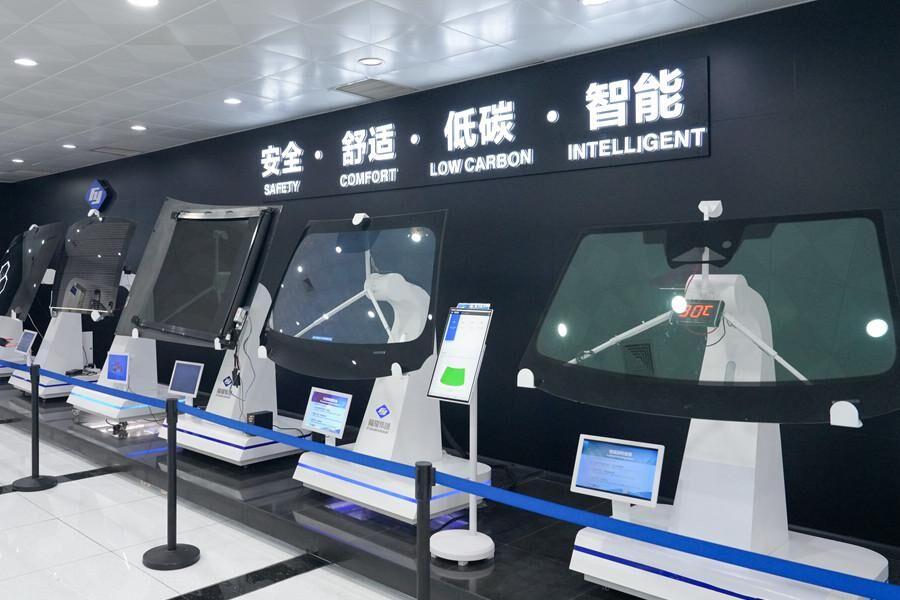
Photo taken on November 28 in the
exhibition hall of Fuyao Automotive Glass Engineering Research
Institute. Photo by Xiao Heyong/Xinhua News Agency
The
automotive glass revolution originates from the restructuring of
product attributes. In the past, consumers mainly valued impact
resistance and shatterproof performance of auto glass. Nowadays,
automotive glass has developed into an intelligent terminal
integrated with diverse advanced technologies.
Such changes
have greatly upgraded travel experience, and the application of
AR-HUD is a typical example, which relies heavily on well-adapted windshields.
In
traditional driving scenarios, drivers need to frequently look down
to check dashboard data and navigation routes. Though the action
takes little time, it brings huge hidden dangers. When driving at
high speed, taking eyes off the road for merely 3 seconds allows the
car to travel dozens of meters, greatly raising traffic accident risks.
AR-HUD
effectively solves this problem. Supported by specially optimized
windshields that meet strict standards on light transmittance,
refractive index and flatness, it clearly projects core driving
information including vehicle speed, fuel consumption and navigation
routes right in front of drivers’ field of vision. Drivers can
obtain all needed information without changing driving postures or
looking away from the road, which greatly improves driving safety.
Apart from
safety optimization, enhancing user comfort is also a key direction
for automotive glass innovation. According to relevant technical
principals, with accelerated intelligent and connected development
of the auto industry, panoramic sunroofs have been widely adopted.
Their ultraviolet absorption capacity affects user experience, while
signal shielding performance directly influences vehicle
communication efficiency, becoming core factors restricting product
competitiveness and user satisfaction.
Nowadays,
many new energy vehicles are equipped with intelligent dimmable
glass, which can adjust light transmittance as needed to block
strong light and ultraviolet rays and protect in-car privacy.
Meanwhile, leading automotive glass manufacturers including Fuyao
Group have launched 5G antenna integrated glass, realizing
integrated design by embedding antennas inside glass panels.
As an
important carrier for display interaction and data transmission,
automotive glass is being continuously redefined.
Driven by Dual Forces: Market Demand and Technological Innovation
The
intelligent-oriented automotive glass revolution is no
coincidence, but jointly driven by upgraded market demands and
continuous technological breakthroughs.
In 2024, sales volume of new energy vehicles accounted for
40.9% of total new car sales in China. The vigorous development
of domestic new energy vehicles has reshaped the industrial
landscape and brought new development opportunities to the
automotive glass industry.
"Different
from traditional fuel vehicles, new energy vehicles differ not
only in power systems, but also in intelligent transformation,
which creates great opportunities for us to integrate various
functional applications into a single piece of automotive
glass," said Huang Xianqian, Vice President of Fuyao Group.
His words reveal the core logic of industrial transformation.
AR-HUD
requires customized windshields; intelligent dimmable skylights
need to balance heat insulation and lightweight design; LiDAR
integration puts forward strict requirements on light
transmission performance of glass. Continuous upgrading of
market demands keeps promoting iterative updates of automotive
glass products.
Sustained
technological breakthroughs lay solid foundations for market
demand fulfillment. "Domestic intelligent vehicle industry
is developing much faster than before," Huang Xianqian
added. To maintain leading advantages, enterprises must
strengthen core independent research capabilities.
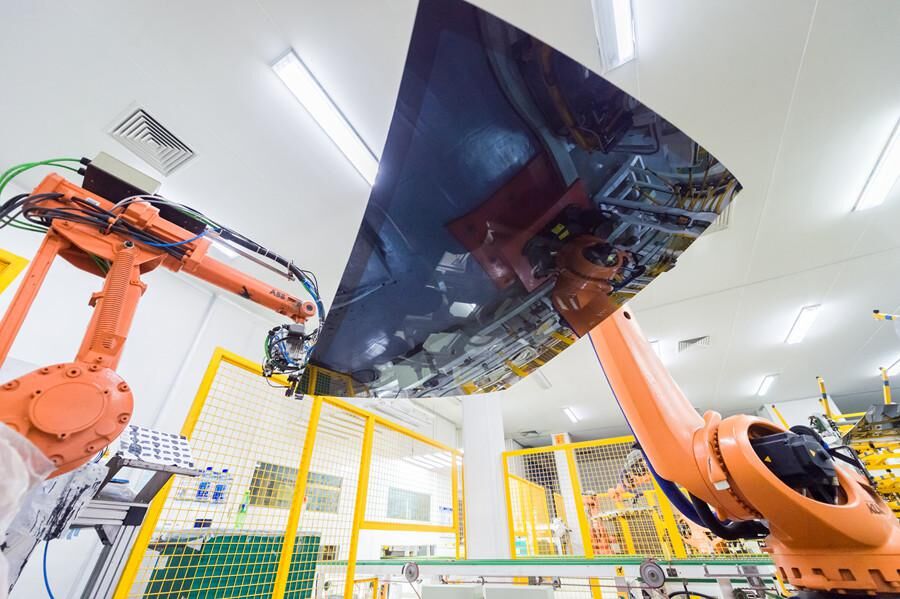
Photo of
intelligent automatic production lines at Fuyao Fuqing Green Smart
Factory, provided by Fuyao Group
Strong
R&D capability constitutes the core competitiveness. Fuyao
Group has built a global R&D team of over 5,600 members,
accounting for 15% of its total staff, with its R&D investment
reaching 1.678 billion yuan in 2024. Leading enterprises also
actively carry out joint R&D with new energy vehicle
manufacturers to accelerate technology commercialization.
"In
the era of intelligent vehicles, automotive glass is no longer a
passive protective accessory, but an active interactive
technological carrier that undertakes core in-cabin intelligent
experience," stated Yang Zhongping, Deputy Secretary-General
of China Association of Automobile Manufacturers. He pointed out
that joint R&D between top glass enterprises and new energy
vehicle brands forms a positive cycle where demands guide R&D
and research achievements empower product upgrading.
Market
demands define development directions, while technological
innovations pave the way for industrial upgrading. Jointly driven
by the two forces, the automotive glass industry is transforming
from traditional manufacturing to high-tech integrated
manufacturing, becoming an indispensable part of the intelligent
travel ecosystem.
Improved
Services & Talent Cultivation Boost Long-term Industrial Development
By the end
of September 2025, China’s vehicle ownership had exceeded 360
million units, fostering a huge automotive aftermarket market. As
a key link in the industrial chain, automotive glass installation
directly determines the practical application of technological
achievements, and service quality greatly affects consumer experience.
"Automotive
glass installation is the final step to implement industrial
standards and a core driving force for service upgrading,"
said Tso Fai, Chairman of Fuyao Group. In the past, the automotive
glass aftermarket was troubled by three major problems:
counterfeit products, inconsistent operation standards and
undervalued service value. To solve these pain points, Fuyao
adheres to the development path of standard guidance and
ecological co-construction.
Besides,
hidden problems including fragmented industrial data and complex
glass specifications lead to low recognition accuracy of
automotive glass, and even trigger chain reactions in supply
chains due to identification errors.
"In
the U.S. automotive glass aftermarket, consumers bear an average
implicit cost of about 20 US dollars per glass installation caused
by wrong part identification, mainly due to disordered independent
industrial coding rules," introduced Curie Chen, President of
Fuyao ARG Group. This highlights the urgency of unified industrial standards.
Fuyao has established China’s first unified automotive glass
standard coding system CARG to build a universal digital language
for the industry, and promoted the one-product-one-code
traceability system to let consumers learn full lifecycle
information of each genuine Fuyao glass. Meanwhile, Edows has
built the AGTSS automotive glass technical service system,
embedding unified standards into every procedure including
disassembly, installation, repair, ADAS calibration and window
film application, perfectly completing the final service link.
"High-quality manufacturing development relies on joint
efforts of all industrial chain participants rather than
individual enterprises. It is essential to break industrial
barriers via unified standards and share industrial values through
ecological cooperation," said Guan Qingyou, President of
Rushi Finance Research Institute. Such collaborative mode
integrates high-quality products and professional services to
elevate overall industrial value.
If standardized services serve as logistical support for the
automotive glass revolution, professional talents are the core
engine driving the industry transformation from Made in China to
Intelligent Manufacturing in China.
Leading enterprises take the lead in talent training and
layout optimization. Fuyao Group cooperates with Edows to build
online and offline training platforms, carry out joint research
projects with global supply chain partners, universities and
research institutions, and cultivate top-tier professional
research teams. It also holds industrial skill competitions to
encourage technicians to polish glass repair and installation skills.
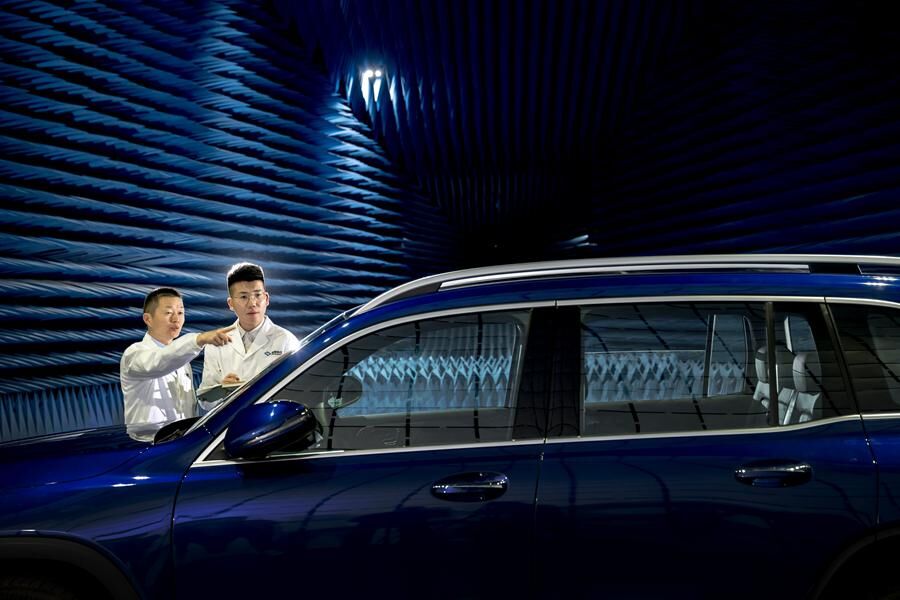
Photo of Fuyao
Group researchers conducting scientific research, provided by Fuyao Group
As major
talent training bases, universities are also actively adjusting
talent cultivation orientations to meet industrial demands.
"Excellent skilled craftsmen are nurtured through on-site
practical practice rather than mere classroom learning," said
Xi Haitao, Party Secretary of Changzhou Vocational Institute of
Industry Technology. The transformation from traditional
functional glass to intelligent interactive terminals calls for a
large number of interdisciplinary professionals.
Focusing on new automotive materials, intelligent connected
technology and intelligent manufacturing, Changzhou Vocational
Institute of Industry Technology dynamically adjusts academic
majors to align talent training with industrial upgrading, and
provides targeted talent support for enterprises to better connect
talent chains with industrial chains.
Tiny automotive glass carries technological innovations and
gathers professional talents, which together form strong driving
forces for high-quality development of China’s manufacturing industry.
Contributors:
Xiao Heyong, Han Menglin
Editor-in-charge:
Liu Yang